

Soundgas Sounds

Tony Miln on Soundgas Sounds
Tony and Soundgas have spent more than fifteen years sourcing, restoring and documenting some of the most unusual vintage recording equipment ever made. Alongside more common Binson Echorecs, Roland Space Echo tape delays and Tony’s beloved EMS synthesisers to rare drum machines and exotic instruments, to studio consoles and obscure effects units, the workshop and studio have become a focal point for musicians, engineers and producers who share this obsession with characterful sound.

Along the way, thousands of recordings have been made while testing, servicing and demonstrating this equipment. Many of those recordings have appeared in Soundgas videos and Instagram posts, where the focus is rarely on pristine production. The emphasis is very much on what happens when old circuits are pushed, misused and explored in ways the designers may not have anticipated.
Soundgas Sounds grew out of that archive. I sat down with Tony to find out more.

What is the idea behind Soundgas Sounds?
This is something I have wanted to do for a very long time. It is one thing to be sourcing and restoring and selling all these incredible vintage pieces of gear. When they leave our hands and go out into the world to make music that is great, but it always seemed a shame not to be able to share the sounds they create more widely.
There are plenty of sample packs out there, but there are not many places like Soundgas. I do not think there is anywhere that has quite the same variety - and slightly crazed - selection of gear. So it always felt like a bit of a no brainer that at some point we should start making these sounds available.

We already have over fifteen years of recordings. Most of what we demo on Instagram and YouTube has been recorded, so there are terabytes of material in the archive that we can mine for sample packs. The first packs we have produced are really just a snapshot of what is coming. They are not even the tip of the iceberg. They are more like the snowflake on the tip of the iceberg.
If you are familiar with our Instagram channel then you will be at home with the material released by Soundgas Sounds.

How is your approach different from other sample libraries?
From the beginning I knew I did not want this to be like other sample libraries. Our approach to sound and sonics is quite different from most of what I see out there. If you are used to something like Splice you might well find that our packs are very different.
There is a lot of noise in what we do. We are not trying to produce pristine ultra clean sounds. We are much more interested in textures and artefacts. What has always fascinated me is what happens when you push signals and circuits in ways that are not conventional, and what happens to sounds when gear is used in ways it was not originally designed for. That is where a lot of the interesting character comes from: the sonic space between the intentional, if you will.

Can you give an example?
A good example is the Grampian 636 spring reverb. It was designed as a high quality reverb in the 1960s, but its main use now is often for the distortion and drive you can get from the germanium transistors in the mic preamp circuit. The original designer would probably be horrified to hear what we do with it.
But I love that unintended use of equipment. It is something we talked about recently in the Gas Club with Hugh from Fieldtone and Ben from Audio Computer. You design something for one purpose and then someone immediately comes along and uses it in a way you never expected. That is one of the wonderful things about music gear. There are unlimited combinations of pieces of equipment and everyone approaches hardware differently.

Why is hardware still so important to you?
For me hardware is still where the magic is. You cannot yet replicate the complexities of analogue and early digital hardware and the way they behave when they are pushed and abused. And a lot can happen in the way you interconnect difference pieces - especially when you do it ‘wrong’ - things happen. Happy accidents.
Soundgas Sounds is very much about capturing the spirit of sonic adventure. Much of it so far is essentially the sound of our Instagram channel, and if you love what you hear there you will probably love the sample packs. One of the most rewarding things so far has been hearing people say that they do not normally use sample packs but they absolutely love these and want more. For me that has been really satisfying because the collection and sounds are quite personal.

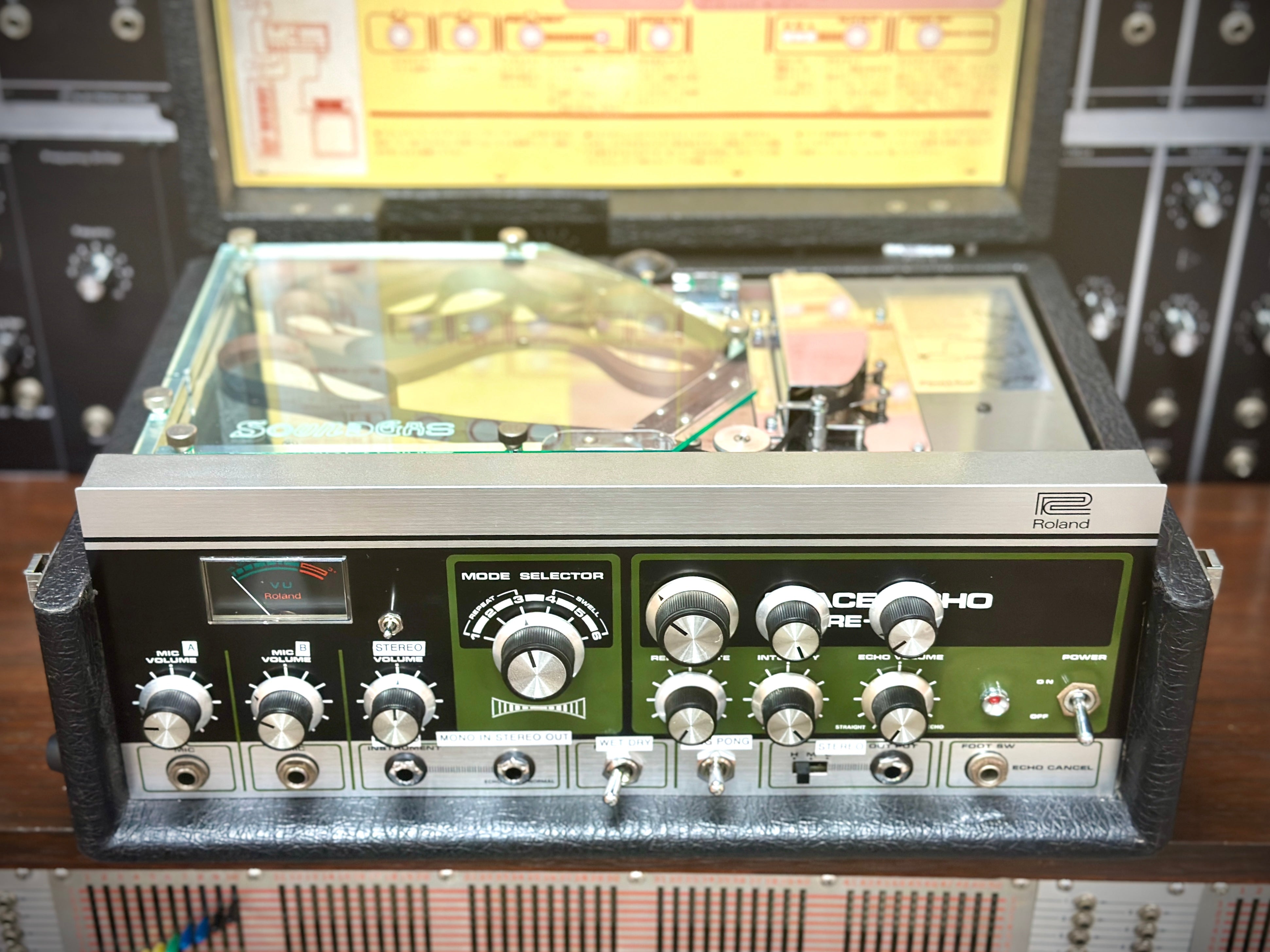
A lot of the recordings are made using our 636 series preamps, our Stereo Roland Space Echoes, and the ex BBC Bristol Audix desk that belonged to Massive Attack and was used to record Mezzanine. These form a big part of the signature sound of the Soundgas studio.

What influences your approach to sound?
My background is not the conventional route through recording studios working with bands - I’ve done that but it’s not my main area of experience. My inspiration comes much more from people who used the studio itself as an instrument.
The Jamaican dub pioneers are hugely inspiring to me. Lee Perry, King Tubby, Scientist, Prince Jammy and the people working around them. And of course Eno - especially his work with Bowie and Visconti and Harmonia. Another big influence has been the German studio tradition around Conny Plank and the whole Krautrock scene. Bands like Cluster and Kraftwerk approached the studio in incredibly creative ways and that spirit has had a big impact on how I think about sound and recording.

Often it was simply a case of not having the piece of gear you wanted, so you would combine other pieces of gear and see if you could get somewhere close. I remember when we set up our first studio in the early 1990s I was trying to recreate some of the sounds from Stevie Wonder's recordings with Malcolm Cecil and the TONTO synthesiser. We had nothing like that at our disposal. What we had were (at the time) cheaper old analogue synths like a Korg MS10, Yamaha CS5, Moog Prodigy and the Roland HS60 (which was essentially a Juno 106 with speakers). I remember using the external filter of the MS10 together with a wah pedal and distortion to try and recreate some of the textures I was hearing on those incredible records. Unsurprisingly I didn’t get very close, but that kind of experimentation is still very much part of what we do.

Do simple setups still inspire experimentation?
Absolutely. Guitar pedals are wonderful. They are such a direct route into experimentation and sound design. You can pick up very cheap pedals, combine them with a small mixer and you can have a miniature studio set up that has as many effects and options as King Tubby had, albeit with perhaps less of the sonic oomph of gear made in an era before cost and convenience dictated design decisions.
A simple setup might be something like a Boss DD3 delay, a chorus, a phaser and a distortion pedal running through a small Tascam mixer. With something like that and a drum machine you already have an incredible amount at your disposal. I can be very happy with a set up like that.

You have collected drum machines for years. Will those appear in Soundgas Sounds?
Yes, very much so. I have been collecting drum machines, rhythm machines and beatboxes for decades with the idea that one day we could share their sounds.
We have things like the Elka Drummer One, much loved by the German bands, and the Farfisa Rhythm Maker 10 and Vox Percussion King, which were the two beatboxes that Kraftwerk modified for their drum kit in the early years. There are already recordings of drum machines available online, but I want to approach it from a Soundgas perspective.
That means recording them through the kinds of signal chains we use in the studio. Things like the Grampian 636 preamps, our Roland stereo Space Echo units, the Schulte Compact Phasing and of course the Audix console. Those signal chains change the sound completely and can can transform a mild mannered beatbox into a snarling techno monster!

How do you feel about the way many sample library beats are recorded?
Many sample libraries beatboxes are recorded very cleanly and very carefully with great attention to detail. For me that often misses what I love about these machines. The noise, the variation between hits, the small imperfections. Those imperfections are part of the character.
When computers replaced hardware samplers in the mid 1990s I felt something was lost. I missed the sound of an Akai sampler on beats. When I started using the onboard sampler inside a computer something of the punch disappeared. Convenience is wonderful, but sometimes we lose something along the way.

What are the plans for the future of Soundgas Sounds?
We have launched with a selection of very accessible packs featuring a diverse lucky dip of sounds that people seem to be enjoying, but there is a huge amount more material in the archive. Preparing the recordings properly takes time and care, so one idea is to build a larger online library where people can access a much wider collection of recordings and select parts at will. We are also considering a subscription or Patreon type model that would allow us to spend more time developing the library and releasing new material regularly.

I am very conscious of how privileged we are to play with these incredible instruments and hope that Soundgas Sounds can in some way democratise access. I'd like more people to be able hear and play with them, or at least get the sounds into their music. Most of us can only dream of playing a real Roland Jupiter 8 for a few hours, let alone spending a couple of weeks with a System 700. We aspire to open up access to the studio for writing /stem processing sessions in future and bring the sounds of more rare beasts like these into people's productions.
 A big part of this is freeing up time and resources to restore super rare machines such as the Movement Drum Computer and make their sounds available. Only 30 or so were produced and we’ve been slowly chipping away at bringing it back to life. Another is the Music Percussion Computer - the MPC-1 - which I love and are very hard to find in good working condition. I’d love to see us spending more time building really unique packs and sounds for others to use.

We would also like to collaborate with engineers, producers and musicians and release their sounds through the Soundgas site.
Are you planning to release music from the Soundgas studio as well?
Yes. I have wanted to release music under the Soundgas label for a long time. I have lots of recordings and ideas that started life as demos and in some cases are still essentially demos. Rather than trying to perfect everything I am planning to release a series of mixtapes called WIP, Work In Progress. That allows me to share the music as it is without worrying about finishing every track ‘perfectly’. As with the sample packs, over time I’ve found I tend to prefer the sound of recordings with the ‘mistakes’, flaws, and character left intact.
Soundgas Sounds sample packs are available now through the Soundgas site. New releases are being added regularly.

Further Reading
Find out more about Soundgas Sounds Promotions and our chosen charities here.
Soundgas At Abbey Road (Part One)
Soundgas are not at Gear Expo in London this weekend
Related Posts

Soundgas are not at Gear Expo in London this weekend

Soundgas At Abbey Road (Part One)

Best Vintage Spring Reverbs Compared: Soundgas Springathon
Product Launch - The Soundgas Roland RE-2101 Stereo Space Echo is Here

Soundgas Type 636 Preamp Series Update: Complete Guide to Design, Build, and Availability
What's Your Favourite (Single Head) Tape Echo?
