
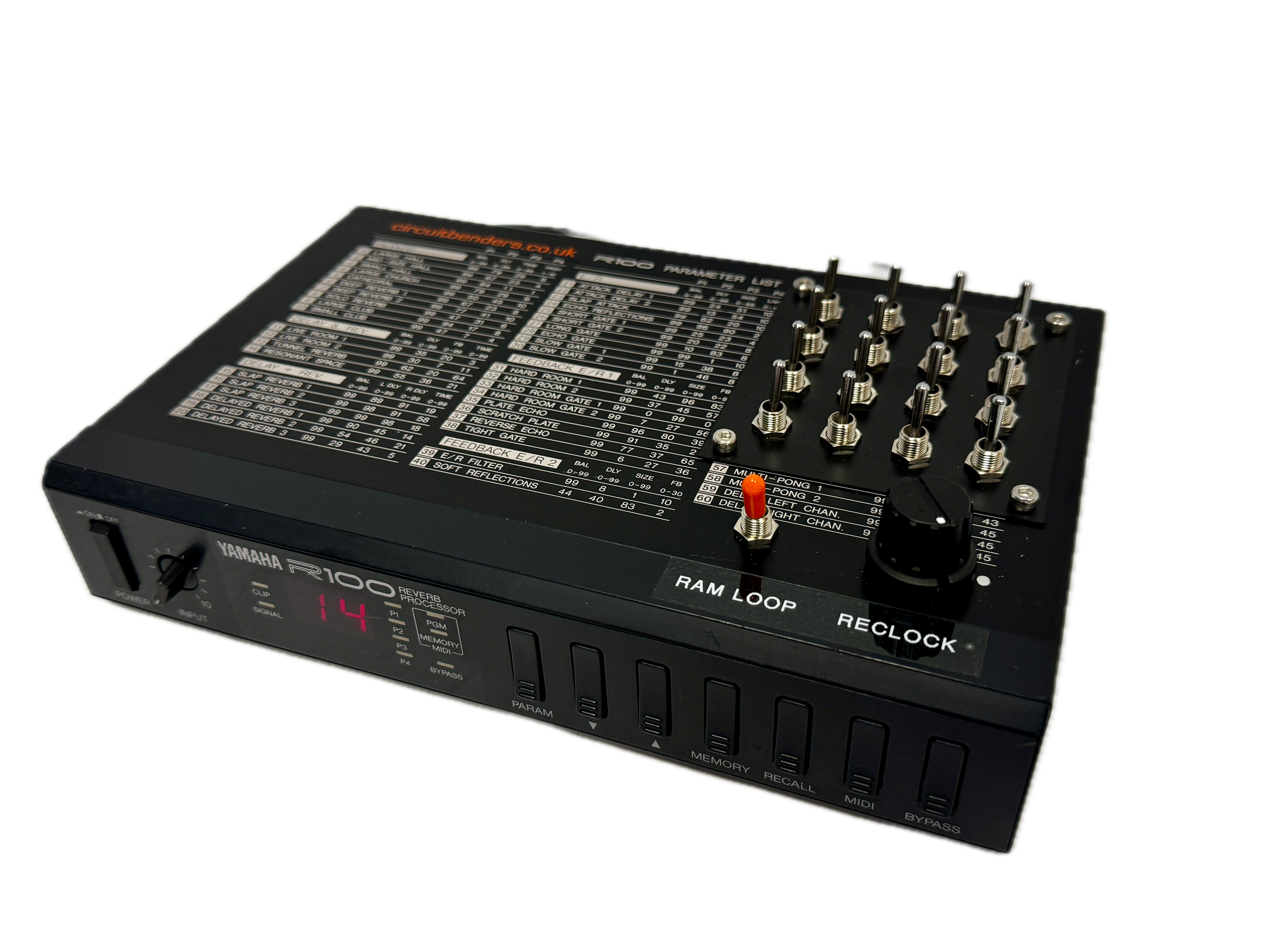


Yamaha R100 Reverb Processor Circuitbent - SN QH01013
Yamaha R100 Reverb Processor Circuitbent - Serial number QH01013 - for sale in imperfect weird working order following a full bending courtesy of Circuitbenders.
Borrowing heavily from Circuitbenders' own description:
The Yamaha R100 is essentially a stripped-back REX50, sharing what we'd wager is the same reverb firmware, but without the modulation, distortion, or the REX50's legendarily questionable pitch shifting. What you're left with is the reverbs and a selection of delay effects, which is no bad thing.
None of the effects here are smooth, transparent, or any of the other words that get thrown around in reverb marketing. They're grainy, coloured, and resolutely lo-fi, which is precisely why people seek these units out. There's a quality to these old Yamahas that modern hardware and plugins simply can't replicate, no matter how hard they try. Objectively, by any measurable standard, they shouldn't be this compelling. And yet, just like the REX50, something about them makes you not want to stop listening.
This one has been modified, and then some.
The Mods:
A 4x4 RAM glitching matrix – sixteen switches in total – operates across both the reverb and delay effects. Different switch combinations produce what variously sounds like comb filtering, audio chopping, bit crushing, distortion, and something we've given up trying to describe precisely and are simply calling audio smearing™. Each switch has its own characteristic flavour – a particular chopping rate, an aliasing frequency – but those characteristics shift depending on which other switches are active at the same time.
The rule is simple: you need at least two switches engaged for anything to happen, but once you're combining them, the results multiply in genuinely unpredictable and useful ways.
A reclocking knob sets the system clock speed for the RAM and both the ADC and DAC converters. This has two significant effects. First, it dramatically extends the reverb and delay times beyond anything the stock unit can achieve – dialling down the clock takes reverbs from short, metallic ambiences at the top of the range to vast, grainy, crumbling washes of sound at the bottom. Second, because it controls the converter clock rate, it simultaneously adjusts the sample rate of the audio passing through the unit.
At higher-than-stock settings the audio quality actually exceeds the original machine; at lower settings, with the effects bypassed, the R100 becomes a fully standalone, continuously variable bit crusher. A small silver dot marks the position corresponding to the unit's standard operating frequency, so you always know where home is.
A RAM loop switch captures whatever is currently sitting in the effects sample RAM and holds it in a continuous loop until the switch is released, at which point normal processing resumes. The switching matrix remains active while the loop is running, and will cut, splice and distort the looped material into shorter repeating sections – but this all happens non-destructively, so releasing the switches returns you to the original loop intact.
It's a genuinely strange and singular piece of equipment, made considerably stranger. If you know what these do to a mix, you already want one. If you don't, give it ten minutes and you surely will.
PRODUCT INFORMATION
SHIPPING INFORMATION
RETURNS & REFUNDS


OTHER VINTAGE GEAR


DON'T JUST TAKE OUR WORD FOR IT

Thank you @soundgasltd, shes a beaut...
If not a new language, then at least a very challenging, old dialect that will take me some time to assimilate. I've been waiting a long time for the challenge. Thank you @soundgasltd, she's a beaut..and noboy prepares and packs like you fine folks.
Justin Meldal-Johnsen

Impeccable service, sales and support...
When you are spending big money on vintage gear it's nice to have the confidence of impeccable service, sales and support... some of the best in the industry! Impeccable people, incredible equipment... my poor, poor fiance.
James DLR - Sofa Sound/Metalheadz